
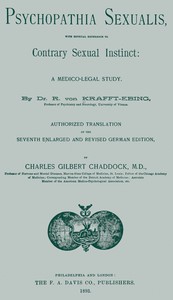
Psychopathia sexualis: With especial reference to contrary sexual instinct
Let's get this out of the way: this book has no plot. There are no main characters. Instead, think of it as a massive, unsettling case file. Dr. Richard von Krafft-Ebing, a respected German psychiatrist, compiled hundreds of anonymous patient reports. He documented everything from homosexuality (which he called 'contrary sexual instinct') to fetishes, sadism, and masochism (terms he actually helped popularize). The 'story' is his attempt to classify these behaviors as medical conditions, often linking them to heredity or 'degeneracy.' It's a cold, diagnostic look at the private lives of people who were, at the time, considered mentally ill or criminal.
Why You Should Read It
This book is a time capsule. It’s crucial for understanding how modern psychology and sexology were born. Reading it today is a strange experience. You can see the seeds of future understanding, but you're also confronted with the harsh, pathologizing language of the era. It forces you to think about how society creates 'normal' and how that definition changes. It’s not an easy or comfortable read, but it’s incredibly revealing about the attitudes that shaped laws, medicine, and lives for generations.
Final Verdict
This is not for casual readers looking for a story. It’s perfect for history buffs, psychology students, or anyone interested in the origins of LGBTQ+ studies. It’s a challenging primary source that shows us how far we've come—and sometimes, how some prejudices still linger in different forms. Approach it with a critical mind and historical context.
This digital edition is based on a public domain text. Use this text in your own projects freely.
Ashley Gonzalez
7 months agoWhile browsing through various academic sources, the narrative arc keeps the reader engaged while delivering factual content. An excellent example of how quality digital books should be formatted.
Jennifer Miller
3 months agoI stumbled upon this title during my weekend research and the transition between theoretical knowledge and practical application is seamless. I'll be recommending this to my students and colleagues alike.
Joseph Thomas
8 months agoFrom a researcher's perspective, the historical context mentioned in the early chapters is quite enlightening. A solid investment for anyone's personal development.
Michael Harris
3 weeks agoThis was exactly the kind of deep dive I was searching for, the data points used to support the main thesis are quite robust. I feel much more confident in my knowledge after finishing this.








Michael White
1 year agoExceptional clarity on a very complex subject.